Research
My research explores the computational principles underlying neural information processing and learning, from the statistical properties of neuronal activity and the biophysical constraints shaping neural responses to biologically plausible mechanisms of learning in recurrent neural circuits.
Biologically Plausible Credit Assignment
How do recurrent neural circuits assign credit and distribute learning signals without conventional backpropagation?
My current research investigates biologically plausible mechanisms of credit assignment in recurrent neural networks. Building on local learning rules, I am developing approaches to infer functional feedback pathways from neural activity, behavioral errors, and learning outcomes.
A central objective is to understand how neuromodulatory systems might implement these feedback signals. By integrating computational models, large-scale neural recordings, and neuromodulatory receptor expression data, this work aims to identify candidate mechanisms through which neuromodulators shape learning.
Ongoing research
Biophysical Constraints on Neuronal Firing
How do the biophysical properties of neurons constrain their firing rates?
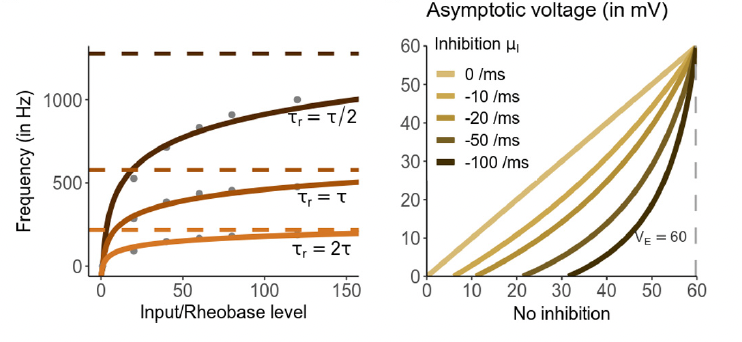
Many simplified neuronal models predict firing frequencies that increase indefinitely with stimulation, contrary to physiological observations. We investigated whether intrinsic biophysical properties could account for firing-rate saturation without imposing an artificial refractory period.
By comparing four integrate-and-fire models, we demonstrated that combining reversal potentials with dendrite–soma coupling naturally produces an upper bound on firing frequency. Neither mechanism alone is sufficient, highlighting how neuronal morphology and membrane biophysics jointly shape neuronal input–output transformations.
Tomar, R., Smith, C. E. & Lánský, P. (2022). A simple neuronal model with intrinsic saturation of the firing frequency. BioSystems.Variability and Randomness of the Instantaneous Firing Rate
What can the instantaneous firing rate reveal about neural activity that conventional interspike-interval statistics cannot?
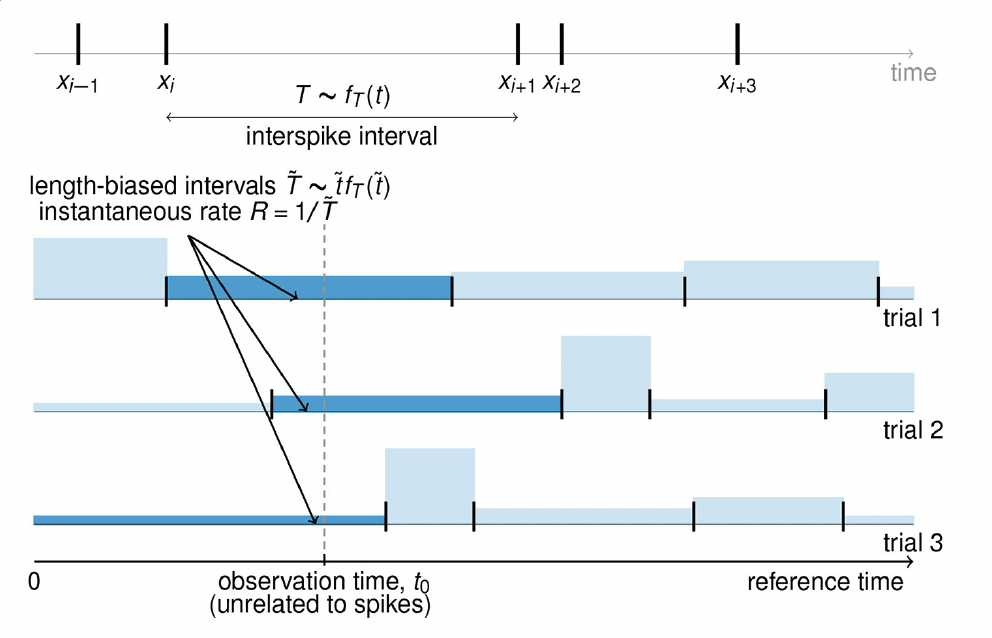
Neuronal variability is commonly characterized through interspike intervals, but these statistics do not necessarily capture the variability and randomness of the instantaneous firing rate.
Using stochastic models of neuronal spiking, we investigated the statistical distributions of instantaneous firing rates and characterized their variability and randomness using measures of dispersion and entropy.
We demonstrated that variability in interspike intervals does not translate straightforwardly into firing-rate variability. Moreover, increasing the randomness of spike timing can either increase or decrease the randomness of instantaneous firing rates, depending on the underlying neuronal model. Applying these measures to experimental recordings illustrated how instantaneous firing-rate analysis provides complementary information about neuronal activity.
Publication
Tomar, R. & Košťál, L. (2021).
Variability and Randomness of the Instantaneous Firing Rate.
Frontiers in Computational Neuroscience.
Estimating Neural Firing Rates
How do we extract time-varying neuronal firing rates from spike trains, and how do different estimation methods approach this problem?
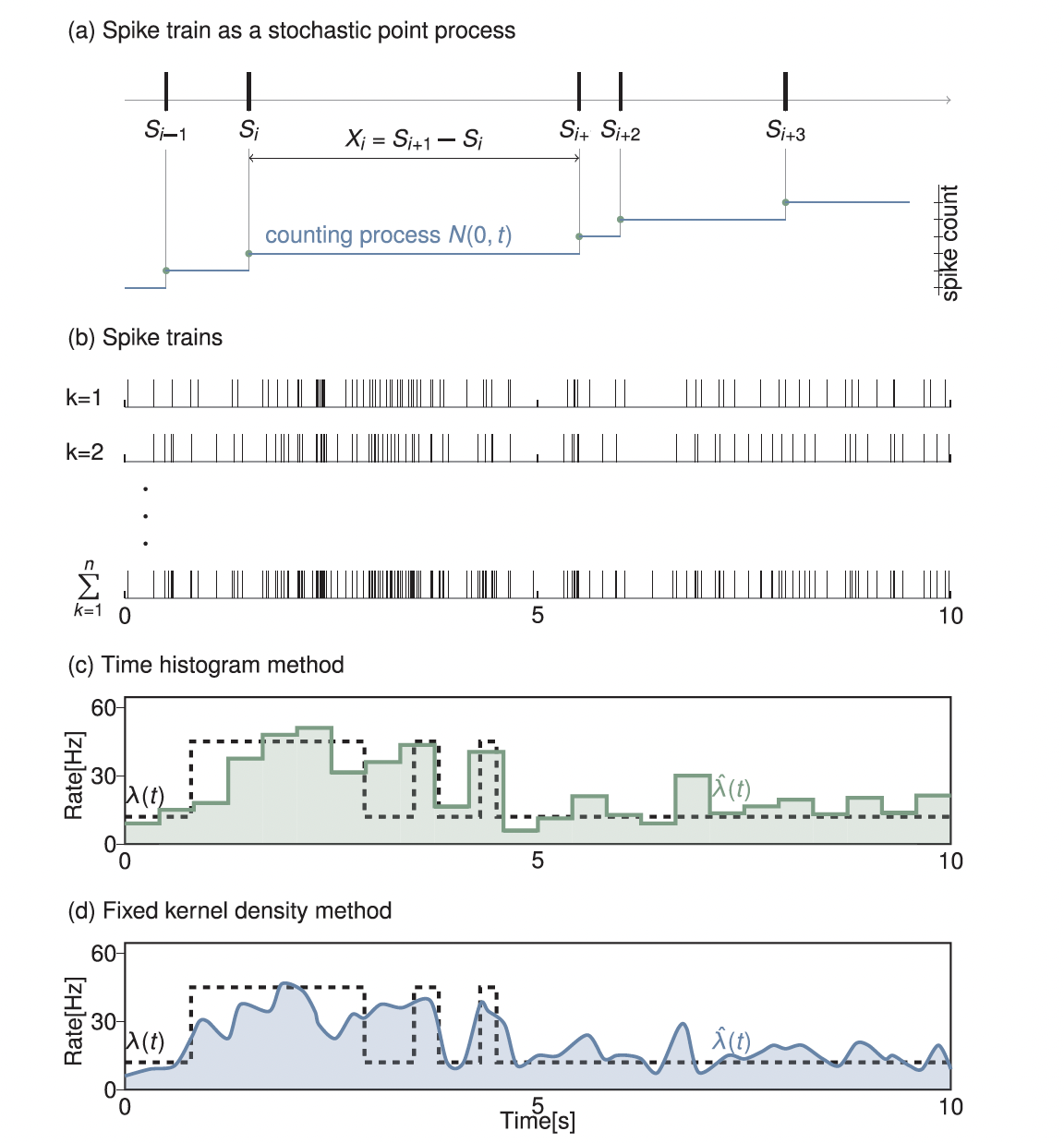
Firing rate is a fundamental measure of neuronal activity, yet estimating its temporal evolution from variable spike trains presents significant statistical challenges. Traditional approaches often rely on averaging across repeated trials, potentially obscuring important temporal features of neuronal responses.
This review examines established methods of firing-rate estimation, from classical time histograms and kernel smoothing to more sophisticated adaptive and Bayesian approaches. It discusses their underlying statistical assumptions, methodological differences, and practical applications, providing an overview of the tools available for studying time-dependent neuronal activity.
Publication
Tomar, R. (2019).
Review: Methods of firing rate estimation.
BioSystems.